
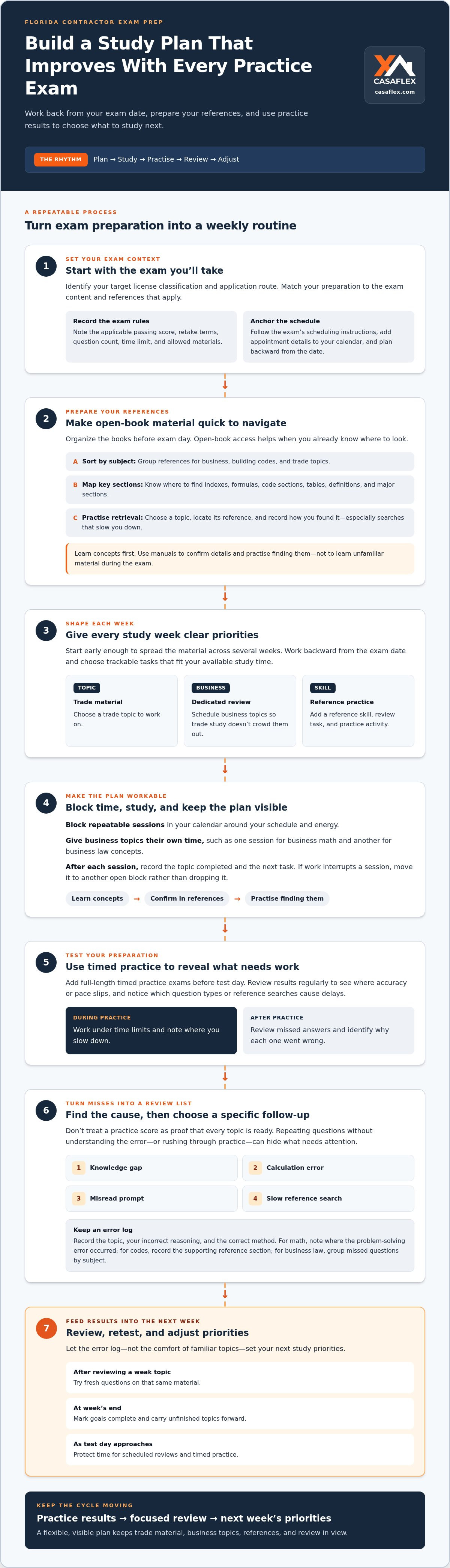
A strong contractor exam study plan for the Florida exam sets weekly goals, organizes reference books, gives business topics dedicated review time, and uses timed practice exams to reveal weak areas. Start early enough to spread the material across several weeks. Practise finding formulas and code sections quickly, so you’re not learning how to use your books during the exam.
The exam can feel like a lot to manage, especially when you’re balancing trade material, business topics, and open-book references. A clear routine breaks that workload into smaller, practical steps you can tackle with confidence.
In this guide, you’ll learn how to organize references, review missed questions, and set weekly study goals around the time you have. You’ll also see how practice exams and focused review can help you prepare with purpose rather than last-minute pressure. Start with a simple schedule, then adjust it as your results show where you need more work.
Key Takeaways
- Arrange your open-book references so you can quickly find formulas and code sections under exam conditions.
- Use timed practice exams to spot weak areas, then focus review on the questions and topics that challenge you most.
- Set weekly study goals that include business topics, scheduled reviews, and practice sessions.
- Match your preparation to your state and exam classification, since contractor exam topics can vary.
Navigating and organizing open-book references
Florida contractor exams require more than owning the right reference books. You need to find formulas and code sections quickly, without searching page by page. Learn each manual’s layout before exam day: know where to find its index, tables, definitions, and major sections. Open-book access helps only when you can navigate the material efficiently.
Florida requirements and eligibility depend on the license classification and application route. Identify your target classification first, then match your preparation to its exam content and references. Keep a short list of the requirements tied to your application so your study materials stay focused on the right exam.
Passing scores and retake policies depend on the specific exam rules. Record the applicable score and retake terms in your study notes. This gives you a clear practice target and helps you plan for the exam you’ll take.
Question counts and time limits also depend on the Florida exam format. Write the figures provided for your exam on a pacing card. Use timed practice to develop a steady rhythm, and note which reference searches slow you down.
Scheduling steps and testing-center options follow the process for your exam. Use the exam’s scheduling instructions to find an available location, then add the appointment details to your calendar. Build your contractor exam study plan around that date, setting aside dedicated time for reference drills.
- Sort your books: Group references by subject, such as business, building codes, and trade topics.
- Map key sections: Make a quick index of useful formulas, code sections, tables, and definitions.
- Practice retrieval: Pick a topic, locate its reference, and record how you found it.
- Review the exam format: Keep the allowed materials and timing details with your study notes.
Don’t rely on the books to teach unfamiliar material during the exam. Study concepts first, then use each manual to confirm details and practise finding them. Build speed with a simple routine: choose a topic, locate its section, and repeat until the route feels familiar.
Identifying and reviewing weak areas
Use full-length timed practice exams to see where your accuracy or pace slips. Review the results regularly, then direct your next study sessions toward the topics causing trouble.
Strategies for Reviewing Weak Areas
For contractor math, work practice problems and note where errors occur, such as choosing the wrong operation. For codes, look up missed topics in the relevant reference and record the section that supports the answer. For business law, group missed questions by subject and revisit each group. These steps turn a score into a focused review list.
Common Exam Failure Mistakes
Common mistakes include treating a practice score as proof that every topic is ready, skipping business material, and repeating questions without understanding why an answer was wrong. Rushing through a timed exam can also make it hard to tell whether errors stem from weak knowledge or poor pacing. Review each missed answer, identify its cause, and choose a specific follow-up task before taking another practice test.
- Track the cause: Label each missed question as a knowledge gap, calculation error, misread prompt, or slow reference search.
- Keep an error log: Record the topic, your incorrect reasoning, and the correct method in one place.
- Retest deliberately: After reviewing a weak topic, try fresh questions on that same material.
- Check your pace: During a timed practice exam, note when you slow down and which question types cause delays.
Let the error log set your next priorities, rather than studying familiar topics for comfort. If guided practice would help you target gaps, explore Contractor License Exam Prep Courses as one way to structure exam-focused review.
Structured weekly study goals
A weekly schedule turns exam preparation into clear tasks you can complete and review. Start early, spread material over several weeks, and reserve time for business topics alongside trade material. Set goals that fit your available study time, then adjust them based on practice results.
Begin with the exam date and work backward. Assign each week a main topic, a review task, and a practice activity. For example, focus on business topics one week, then review missed questions and take a timed practice exam. Set goals you can track, rather than simply writing “study more.”
- Set weekly priorities: Choose a trade topic, a business topic, and a reference skill to work on.
- Block study time: Add repeatable sessions to your calendar, based on your schedule and energy.
- Schedule review: Revisit earlier topics and correct errors before moving to new material.
- Practice under time limits: Add full-length practice exams before test day, then review the results.
Give business material its own place in the calendar so trade study doesn’t crowd it out. For example, set aside one session for business math and another to review business law concepts. A written plan makes it easier to spot and correct omissions.
- After each session: Record the topic completed and the next task to tackle.
- At week’s end: Mark goals complete and carry forward unfinished topics.
- After practice exams: Use missed questions to choose the next week’s review priorities.
- As test day approaches: Protect time for scheduled reviews and timed practice.
Keep the schedule visible, such as in a calendar or study log. If work interrupts a planned session, move the task to another open block rather than dropping it. A flexible weekly routine keeps every topic in view and gives each study session a practical next step.
What topics are covered on the contractor licensing exam in each state?
Exam topics depend on the state and license classification, so don’t assume one state’s outline applies to another. For a Florida exam, organize preparation around both trade material and business topics. Schedule time for each, then match practice questions and reference work to the exam you plan to take.
Start by identifying your state and classification. Then use the applicable exam outline to sort topics into study groups. A Florida candidate might create separate groups for trade knowledge, business concepts, and business math. This makes it easier to spot areas that need practice and keeps unrelated state requirements out of your notes.
State comparisons show why that step matters. The California CSLB listing indicates that the Limited Specialty C-61 classification has no trade study guide because no trade exam is required. That detail applies to this California classification, not automatically to Florida or another state. Check what the outline says for your exact classification before building a topic list.
Use a simple state-and-topic checklist to guide your preparation:
- State: Write Florida or the state where you’ll take the exam.
- Classification: Record the license category tied to your application.
- Exam areas: Copy the topics from the applicable outline into separate study groups.
- Practice focus: Include trade questions, business material, and business math where they apply.
Keep your checklist specific. If your Florida outline separates business content from trade material, schedule time for both instead of treating business as an afterthought. If you’re comparing licenses across states, create a separate topic list for each. A NASCLA Accredited Exam may be useful for contractors planning to work in more than one state because it is accepted in multiple states. Its usefulness depends on where you plan to work.
Before each study week, compare your tasks with the outline for your state and classification. This quick step keeps your preparation focused on the exam ahead, not another state’s rules or topics.
Casaflex: Contractor License Exam Prep Courses
Casaflex offers Contractor License Exam Prep Courses for candidates who want structured support alongside their own study schedule. If you need help turning exam topics into focused review, the courses provide an exam-preparation option designed for licensing study.
For open-book preparation, Highlighted Study Books can support faster reference practice. Realistic Practice Exams let you apply what you’ve reviewed and identify topics that need more attention. Contractors preparing for work across multiple states can also explore NASCLA Accredited Exam Prep.
Choose the resource that fits your current challenge: course structure, reference organization, or practice testing. These tools support exam preparation; they don’t issue a state license. Contact Casaflex to explore the exam-preparation options that fit your study needs.
Make Your Next Study Session Count
Your exam preparation doesn’t need to feel like one long climb. Treat your contractor exam study plan as a working tool: use it to choose the next task, track what’s improving, and redirect your effort when a topic remains difficult. Small, deliberate adjustments keep your preparation focused on what you need to learn.
Before your next session, choose one clear action. Work through practice questions, revisit a difficult concept, or get familiar with a reference you’ll use. Then record what you learned and what needs attention next. This simple habit helps turn study time into steady progress.
If you want structured support for your preparation, Casaflex offers exam-prep resources for contractors. Take the next step and contact Casaflex about exam preparation. Keep your goals clear, stay consistent, and move forward with confidence.
Frequently Asked Questions
Quick Answer: How Can You Prepare for the Florida Contractor Exam and Pass?
Prepare with a focused contractor exam study plan that matches your Florida license classification. Study trade and business material, practise calculations, and use timed questions to identify areas that need more work. For example, if you miss business math questions, review the method, then solve fresh problems. Practise locating relevant reference material, too. Consistent preparation builds readiness, but no study method can promise a passing result.
How should I create a 4-week contractor exam study plan?
Give each week a distinct preparation focus. In the first week, map exam topics and assess your starting point. In the second, tackle difficult trade and business concepts. In the third, review missed questions and practise calculations. In the fourth, take timed practice exams and revisit errors. Adjust the sequence to your exam outline, work schedule, and topics that need extra attention.
How many hours per week should I study for the contractor exam?
Choose weekly study time based on your exam date, current knowledge, and available schedule, rather than copying someone else’s routine. Start by listing the sessions you can realistically protect around work and other commitments. Then compare your practice results with your topic list. If key areas remain difficult, redirect study time toward them; if you’re progressing, maintain regular review and practice.
What are the best contractor exam prep books, courses, and practice tests?
The right resources match your state, license classification, and exam topics. Use relevant reference books to study required concepts, then practice finding information efficiently. Courses can provide structure, while practice tests help reveal gaps and improve test-taking habits. Casaflex offers Contractor License Exam Prep Courses, NASCLA Accredited Exam Prep, Highlighted Study Books, and Realistic Practice Exams for exam preparation.
Are contractor licensing exams open-book, and what reference materials are allowed?
Some contractor licensing exams are open-book, but permitted references vary by state and exam. For a Florida exam, prepare to use reference books efficiently by learning their layouts and practising how to locate formulas and code sections. Match your study routine to the materials permitted for your specific exam. Don’t assume a book allowed for one classification or state is allowed for another.


