
The course with the most features isn’t always the best fit. A useful contractor exam prep course comparison considers how practice tools, instructor access, study format, scheduling, and progress tracking match your needs. The right choice makes it easier to study consistently and identify what needs more work.
Practice exams are a sensible place to start, but they’re only part of the picture. Flexible scheduling can help you fit study around work, while instructor support and a clear plan can provide structure when you need it.
This guide compares common course formats and support features to help you choose with confidence. Consider what each option offers and how it fits your routine, then weigh practice resources, instructor access, scheduling, and progress tracking side by side.
Key Takeaways
- Match practice tools to your exam: realistic simulations and focused question banks can help you build familiarity and spot weak areas.
- Choose the level of instructor access that fits how you learn, especially if you benefit from feedback when questions come up.
- Weigh schedule flexibility against built-in structure when comparing self-paced, live, blended, and classroom study.
- Use study plans and progress tracking to keep preparation moving, then explore Casaflex courses and practice resources for focused exam prep.
Digital practice tools and question banks
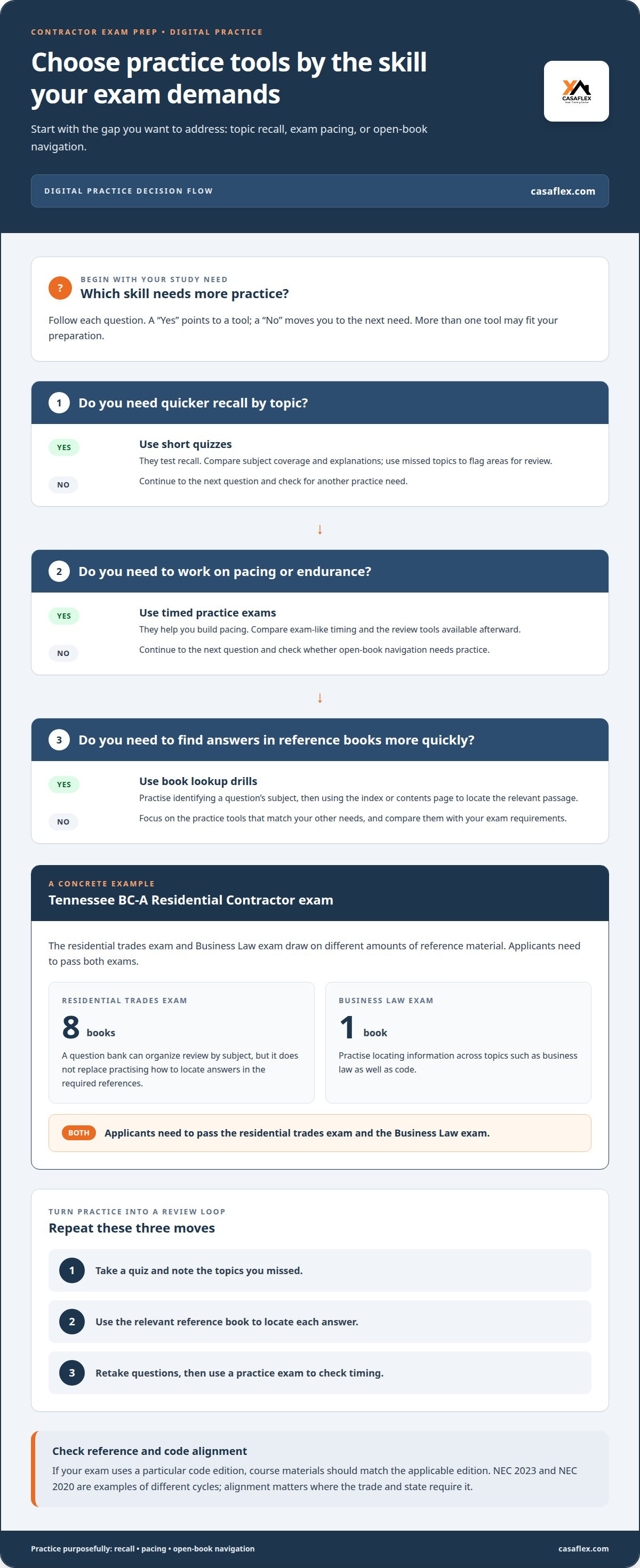
Digital tools serve different purposes in contractor exam preparation. Quizzes test recall, while timed practice exams help you build pacing. Simulations let you rehearse in a format similar to the actual test. For a residential license exam, the best fit depends on whether you need quicker recall, better timing, or more practice navigating exam-style questions.
Use Tennessee’s BC-A Residential Contractor exam as a concrete example. Its residential trades exam draws on information from 8 books, while the Business Law exam draws from one book. Applicants need to pass both exams. A question bank can help organize review by subject, but it won’t replace practicing how to locate answers in the required references.
Open-book lookup practice builds a distinct skill. Start with a question, identify its subject, then use the index or contents page to find the relevant passage. Contractor licensing exams are open-book: licensing boards don’t expect you to memorize thousands of details, they expect you to find the right answer quickly. Practise with different topics, such as code and business law, so you learn to locate information rather than memorize answers.
| Practice option | Best use | What to compare |
|---|---|---|
| Short quizzes | Recall by topic | Subject coverage and explanations |
| Timed practice exams | Pacing and endurance | Exam-like timing and review tools |
| Book lookup drills | Open-book navigation | Reference materials and search practice |
Before choosing, connect each tool to a task. Use quizzes to flag weak topics, full practice exams to rehearse pacing, and lookup drills to build reference-book speed. If your exam uses a particular code edition, course materials should match the applicable edition. The NEC 2023 and NEC 2020 are examples of different cycles, so code alignment matters where the trade and state require it.
Turn results into a repeatable review loop:
- Take a quiz and note missed topics.
- Use the relevant reference book to locate each answer.
- Retake questions, then use a practice exam to check timing.
Compare tools by topic coverage, exam-style practice, and support for open-book navigation. This keeps your digital practice focused on the demands of your contractor exam.
Instructor access and question response
Instructor access matters when you need an explanation for a missed question, not another guess. Compare how support is delivered, then consider what it covers: a construction concept, exam strategy, or locating an answer in a reference book. Casaflex courses include unlimited coaching and support, alongside practice resources. These details matter just as much as the practice tools when comparing courses.
Course format affects how study fits around your workday. Classroom courses have fixed times and locations, so attendance must fit around job demands. Self-paced online study offers more scheduling flexibility, while live virtual instruction provides scheduled teaching without classroom travel. If you’re balancing job sites and exam preparation, consider which format makes it easiest to keep studying and get questions answered.
Support is most useful when it addresses a specific sticking point. After missing a question about a code reference, for example, note the topic, ask for clarification, and revisit the relevant material. Instructor-led courses can provide real-time feedback and structure, but may require fixed attendance. Self-paced study gives you control over your schedule; the available support channel determines how you can get help with questions.
Access terms and payment policies affect the value of a course. Check the stated access period against the time you expect to prepare, and read the conditions attached to any payment promise. Casaflex offers a “NO PASS - NO PAY” guarantee. Look for clear terms rather than assuming access continues indefinitely. When reviewing student feedback, focus on specific comments about instructor responses and support, rather than general praise.
- Identify the support channel and response process.
- Match live-session times and locations to your work routine.
- Read access and refund terms before choosing a course.
Choose a course that provides useful practice and a workable study routine without adding avoidable disruption to your construction work.
Self-paced online, live virtual, blended, and classroom formats
Format determines how course material fits around work and your learning habits. Self-paced online courses let you study on a flexible schedule, but require self-discipline. Live virtual classes provide scheduled instruction without classroom travel. Blended courses combine independent modules with live sessions or instructor check-ins. Classroom courses offer direct, scheduled teaching at a set time and location.
Choose by matching the format to your main need. If job-site hours shift, self-paced study can make regular review easier. If you learn best by asking questions in real time, live virtual or classroom classes provide a set place for instruction. A blended format can add structure while preserving some independent study. For trades content that needs repeated review, make sure the course material is usable between sessions.
Courses that address state licensing rules should match the applicable licensing board and license classification. State business and law content matters when it is part of your exam. A general course that skips relevant requirements may not prepare you for the right test.
Requirements vary by state, including experience rules, code editions, test formats, and reference materials. According to the Tennessee Department of Commerce & Insurance, applicants must take the Business and Law exam, and some license classifications also require a trade exam. Before choosing a course format, match its content to the state and classification relevant to your licensing goal.
If you’re pursuing a general contractor license, choose preparation that aligns with that classification and its exam content. Trade contractors need material matched to their specific trade and relevant code coverage. No format alone establishes a higher pass rate. Compare clear outcome information and detailed, authentic reviews rather than relying on broad praise.
Courses differ in their textbooks, practice exams, and instruction. Some offer pre-highlighted reference materials or realistic practice exams; others emphasize scheduled classes or online modules. To compare them, identify your license classification, exam content, preferred format, and need for instructor access. Then check each course against those priorities.
Study schedules and progress tracking
A study schedule breaks exam preparation into manageable tasks. Start with the exam topics, then assign each a place in your weekly plan. Track completed lessons, practice results, and questions to revisit. If code questions repeatedly cause trouble, for example, set aside focused review time for that material before taking another full practice test.
Progress tracking should show more than time spent studying. Record which topics you covered, where answers were missed, and whether you can now find those answers in the reference material. A weekly plan, instructor access, and review sessions can add structure to online preparation. Use each practice result to choose the next task, rather than repeating material you already know.
Be cautious about claims that a package reduces study time. Such a claim is useful only if it explains what preparation it measures and how the result was assessed. Your study needs depend on the exam content, your familiarity with the material, and the topics that need more work. A clear progress record helps you assess your plan without treating a promised timeline as a personal target.
When comparing a PSI exam study pack, identify the specific exam it covers and review its materials. Match its practice resources and references to your exam requirements, then fit them into your schedule. A package name alone doesn’t show whether its contents suit your license classification or study needs.
- Set weekly study blocks around work commitments.
- Log topics covered and questions missed after each session.
- Use results to plan targeted review before another practice exam.
Keep the actual exam requirements at the center of your plan. Verify that your study material matches the applicable licensing content, then adjust your next review block based on your progress. For a structured next step, explore contractor exam preparation and build your study routine around focused review.
Casaflex: Contractor License Exam Prep Courses
Casaflex helps contractors prepare for licensing exams with Contractor License Exam Prep Courses, including NASCLA Accredited Exam Prep. If your comparison points to a need for focused practice or clearer study materials, its Realistic Practice Exams and Highlighted Study Books offer relevant preparation resources. Choose these tools to support exam practice and review, then align your study routine with the licensing requirements that apply to your goal. Exam preparation is the next step toward getting ready to test, not a substitute for the licensing process itself. To discuss your exam preparation needs, contact Casaflex.
Choose a Prep Path That Moves You Forward
Turn your priorities into a study routine you can sustain. Decide which practice tools keep you engaged, how much instructor guidance you want, and which format fits your work schedule. Then use those choices to narrow your options. A contractor exam prep course comparison is most useful when it leads to a plan you can follow, not simply a longer list of features.
Casaflex offers Contractor License Exam Prep Courses, NASCLA Accredited Exam Prep, and Highlighted Study Books. If you’re ready to connect your exam goals with preparation options, contact Casaflex to discuss your options. Take the next step with a clear focus, and keep building toward your licensing goal.
Frequently Asked Questions
Need Help Picking the Right Prep?
Start with the license classification and exam you’re preparing for. Then identify your biggest obstacle: finding answers in reference books, building a steady routine, or getting help with difficult topics. If you struggle with exam-style questions, realistic practice may help; if you need structure, consider a guided course. Choose resources that address your actual needs.
Which one should you pick?
Choose a course that matches your exam content and study habits. A general contractor preparing for a business and law exam has different material needs from an electrician reviewing trade topics. Compare course coverage first, then consider format, practice tools, and instructor access. That makes a contractor exam prep course comparison relevant to your situation, rather than a decision based on popularity alone.
Which pass guarantees are real?
A payment guarantee matters when its terms explain what happens if you don’t pass. Casaflex offers a “NO PASS - NO PAY” guarantee. It is a specific payment promise, not proof that every course offers a guarantee or that every exam outcome is assured. Review the terms to understand what the guarantee covers.
Packages can group different resources, such as instruction, study materials, practice exams, and access to support. Their contents and scope affect what a package includes, so the amount in this question shouldn’t be treated as a standard price. Compare the actual components and their relevance to your exam. A larger bundle isn’t automatically a better fit for your preparation needs.
Which contractor exam prep courses are available in the United States?
Casaflex offers contractor exam preparation for Virginia, Maryland, California, the District of Columbia, West Virginia, South Carolina, Ohio, Florida, Georgia, Louisiana, Tennessee, North Carolina, and Arizona. NASCLA Accredited Exam Prep is also available. Choose preparation that matches the license and exam you’re pursuing, since relevant content depends on your licensing path.
Which contractor exam prep courses offer guarantees, refunds, or retake support?
Guarantees, refunds, and retake support are separate terms, so don’t assume one includes the others. Review the applicable course terms to understand how it works, and treat refund or retake provisions as distinct policies. Base your decision on the specific terms and support provided with your preparation.


