
Prepare for a contractor licensing exam by practicing business law, accounting, contracts, bidding, and the trade knowledge required for your state and license type. A contractor practice exam helps you work through these subjects and spot gaps before test day. Trade exam candidates have roughly 2 minutes per question, so practice also helps you build a steady pace.
The material can feel like a lot at first because you’re preparing for more than trade knowledge: business rules and calculations matter, too. Break the content into clear topics, then practice applying what you’ve learned.
This guide explains how business law, accounting, contracts, bidding, and state licensing exam preparation fit together. You’ll learn how practice questions can build familiarity and confidence, and what to look for in study materials that support your preparation.
Key Takeaways
- See how business law and accounting knowledge can shape sound contractor decisions, from business structure to routine calculations.
- Learn what to review in contracts and bids so you can spot key terms and prepare a clear, complete offer.
- Focus your study on your state’s licensing requirements, trade topics, and exam format to make practice more purposeful.
- Use realistic questions and highlighted study materials to identify gaps, strengthen weak areas, and build a steady preparation routine.
Business law and contractor accounting
Business law and contractor accounting connect everyday decisions with questions on general contractor business and law exams. Expect to work through business structures, recordkeeping, financial calculations, and contract responsibilities. Treat each topic as a practical scenario: identify the business decision, choose the relevant information, then calculate or interpret the result.
Business ownership affects how risk and income are handled. A sole proprietorship offers pass-through taxation, but its owner has unlimited personal liability for the business’s debts and liabilities. In an exam question, distinguish how income is taxed from who may be responsible for business obligations. Don’t mistake a tax feature for protection from liability.
Accounting questions test accuracy as much as familiarity with terms. For example, a 6% calculation on $93,500.00 equals $5,610.00. Set up the calculation by converting the percentage to a decimal, multiplying by the base amount, and checking that the result is smaller than the original amount. This sequence helps catch misplaced decimal points.
Business and law exams may ask you to interpret financial records or apply a rule to a short scenario. Read the full prompt before choosing an answer. Mark the key figures, identify what the question asks, and rule out choices that confuse business income with a percentage-based calculation. Review practice-question errors by topic, not just by score.
For Texas candidates, the Texas Department of Licensing and Regulation says the Candidate Information Bulletin lists exam content, passing score, question count, time limit, reference materials, fees, and exam locations. Use these details to organize preparation: match each content area to a study session, then practice calculations and business scenarios under the stated exam conditions. Keep a brief error log with the missed concept, correct reasoning, and a step to avoid repeating the mistake.
Contracts and bidding
Contract questions test whether you can identify the work, price, schedule, and responsibilities described in an agreement. Separate the project scope from the payment terms. For example, a bid may include installation but exclude disposal. That distinction matters when comparing the written offer with the requested work. Review each detail before deciding whether the bid is complete.
Practice reviewing contracts in a consistent order. Identify the parties, project description, payment conditions, schedule, and stated exclusions. Then check how the document handles changes to the work. If a scenario adds a task, determine what the original scope covered and what changed. This helps you avoid assuming every extra task belongs in the initial agreement.
Bidding questions often ask you to compare project requirements with the proposed work. List the materials, labor, and tasks named in the scenario, then flag anything the bid omits or treats differently. For example, if the project requests cleanup but the bid mentions installation only, note the mismatch. Base your answer on the facts provided, not assumptions about standard practice.
Florida General Contractors Contract Administration practice exams contain 10 questions each and can be retaken up to 25 times. Use each attempt to review your reasoning, not just the result. For every missed question, write down the contract detail you overlooked, such as a scope item or payment condition. Then explain why another answer better fits the scenario.
Build a short review routine: read the scenario, mark its key terms, compare the bid with the stated scope, and eliminate unsupported assumptions. Repeat that process with new contract examples. If you want a structured way to prepare for licensing topics, explore contractor exam preparation as part of your study plan.
State contractor licensing exam preparation
Prepare for the state and license type you plan to pursue, and use the exam format to shape your study routine.
Study Guides and Prep Courses
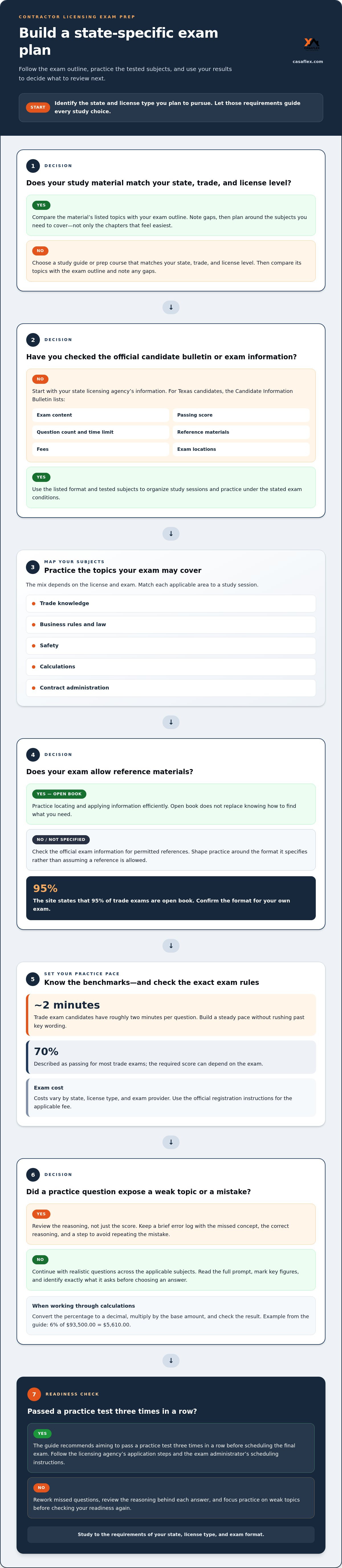
Choose study guides and prep courses that match your state, trade, and license level. Useful materials organize exam subjects, explain key concepts, and give you practice applying them. Compare the listed topics with your exam outline, note any gaps, and build your study plan around them rather than only the chapters that feel easiest.
Passing Score and Exam Cost
A score of 70% is described as passing for most trade exams, but the required score can depend on the exam. Exam costs vary by state, license type, and exam provider, so use the official registration instructions for the applicable fee. To register, follow the licensing agency’s application steps, then use the exam administrator’s instructions to schedule. Keep those steps together with your study plan.
Practice Exam Topics
Practice questions can cover trade knowledge, business rules, safety, calculations, and contract administration. The mix depends on the license and exam. Many trade exams are open book, but that doesn’t replace knowing how to locate and apply information quickly. Candidates have roughly two minutes per question. Avoid rushing past key wording, relying on memory when a reference is allowed, or changing an answer without a clear reason.
Free Practice Exams and Sample Questions
Start with your state licensing agency’s candidate bulletin or exam information. It can outline tested subjects and reference materials; official preparation resources may also include sample questions. Use practice questions to identify weak topics, then review the reasoning behind each answer. Don’t treat a small sample as a full exam. Rework missed questions and aim to pass a practice test three times in a row before scheduling the final exam.
The site states that 95% of trade exams are open book, though candidates still benefit from practicing efficient reference use. South Carolina Business and Law exam preparation is listed for 2025.
What is on a contractor license practice exam?
A contractor practice exam reflects the trade, license type, and exam format you’re studying for. Questions may test code use, safety, calculations, and applied trade knowledge. Treat each one as a scenario: identify the topic, locate the relevant rule or reference, and apply it to the facts. The exact mix varies by exam.
Code-based practice can focus on applying a particular edition, not just recalling terms. A Master Electrician calculation practice test based on the 2023 NEC has more than 100 questions. A separate NEC 2020 practice test includes 100 questions. Notice the edition named in each question set, then keep your study references aligned with that material.
Safety and plumbing examples show how much question banks can differ. The OSHA 29 CFR 1926 practice exam offers 90 unique questions. A plumbing practice exam based on the 2018 International Plumbing Code covers a bank of more than 140 questions. Use missed answers to identify whether you need to review a safety concept, a code section, or the wording of a question.
Fuel gas practice adds another kind of preparation. The International Fuel Gas Code practice exam is based on the 2015 code edition and covers six key areas. Before attempting a question, identify its subject area and the reference edition. Afterward, explain why the correct answer fits. That small review step turns each attempt into focused study, rather than simple repetition.
Choose practice questions that match your trade and licensing goal, then review every answer you miss. Use realistic contractor practice exams to work through exam-style questions and target topics that need more attention.
The Tennessee Limited Licensed Plumber practice test has over 220 questions. Use a question bank of this size to build a steady review routine: work through a manageable set, check each response, and note the subjects that need another look. For missed questions, return to the relevant code material and make sure you understand how it applies, rather than memorizing an answer in isolation. On questions you answered correctly, confirm your reasoning too. This helps distinguish a sound understanding from a lucky guess and gives each practice session a clear purpose.
Casaflex: Highlighted Study Books
Casaflex offers Highlighted Study Books and Realistic Practice Exams to support focused license exam preparation. Use the books to guide your review, then answer practice questions to identify topics that need more attention. This creates a clear study cycle: review a subject, test your understanding, and revisit missed material.
Choose this approach when you need structure for exam topics and opportunities to apply what you’ve studied. Note the areas that remain difficult, such as code references, calculations, or business concepts, and use them to guide your next review session.
Visit Casaflex to explore study materials for your exam preparation.
Turn Your Preparation Into a Clear Next Step
Make your next move fit your licensing goal. Choose the trade and license path you’re pursuing, then shape your study routine around the topics that challenge you most. A contractor practice exam can reveal where focused review will make your next session more useful.
Casaflex offers Contractor License Exam Prep Courses, NASCLA Accredited Exam Prep, and Highlighted Study Books. Choose the option that fits your study needs and supports your next step toward exam readiness.
Contact Casaflex to discuss your needs and explore a preparation approach that suits your path. Keep moving forward with a clear plan and steady practice. You’re building readiness one focused step at a time.
Frequently Asked Questions
What subjects are covered on general contractor license exams?
General contractor exams commonly combine trade knowledge with business and law topics. Questions may ask you to interpret project plans, apply safety practices, calculate job figures, or recognize business responsibilities. For example, a scenario might ask you to choose the next step after a job detail changes. Check your exam’s subject outline, then use its categories to organize your review and practice.
How many questions are on a contractor licensing exam, and what is the time limit?
The question count and time limit depend on the specific exam, license, and state. Trade exam candidates have roughly 2 minutes per question, which offers a useful pacing guide during practice. For example, mark a question that takes too long, continue, then return if time allows. Use the exam’s candidate bulletin to learn its exact format and timing.
How do contractor license exam requirements vary by state?
Requirements vary by state and may also depend on the trade and license classification. One state’s exam may emphasize business and law, while another license path focuses more on trade-specific knowledge. Before making a study schedule, identify the state, license category, exam subjects, and application steps relevant to your goal. This keeps your preparation focused on the right test.
Are contractor license exams open-book, and what reference materials are allowed?
Some contractor licensing exams may be open-book, but permitted references depend on the specific exam. Licensing boards don’t expect you to memorize thousands of details, they expect you to find the right answer quickly. Practice locating information in the references allowed for your test. Check the candidate bulletin for approved materials, edition details, and rules for using books during the exam.


