
Open-book contractor exams let you use approved reference materials during testing, but not any book or tool you choose. Permitted materials vary by state and exam provider. Effective open book contractor exam prep teaches you to find and apply information quickly, not simply collect references.
An open-book test may seem simple because the answers are somewhere in a book. The challenge is knowing which references are allowed and locating the right information while the clock is running. A clear plan makes that challenge manageable.
Here, you’ll learn what open-book contractor exams may allow and how to compare permitted books, study tools, practice exams, and question banks. You’ll also see how timed practice and familiarity with your references can help you prepare with purpose, choose an approach that fits your exam, and build confidence before test day.
Key Takeaways
- Use the exam’s reference list to narrow your book choices and match each title and edition to the test.
- Build a simple system for finding information fast, using permitted book markings and reference features.
- Choose practice questions that help you spot knowledge gaps, then review missed answers and repeat under timed conditions.
- When you want structured support, compare exam prep courses, highlighted study books, and realistic practice exams with your preparation needs.
What Is an Open Book Contractor Exam?
An open-book contractor exam lets candidates use approved references during testing. It still tests how quickly they can find and apply information correctly. Open-book contractor exam prep should develop reference skills, not just familiarity with code terms.
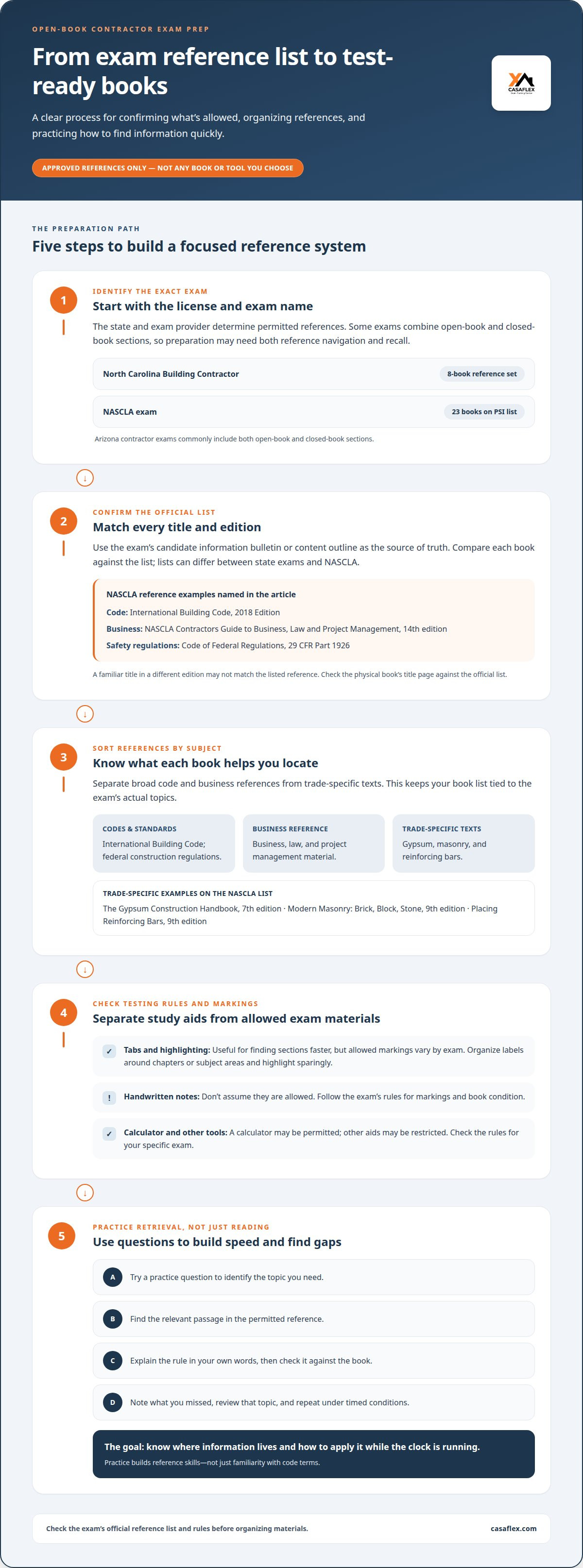
The state and exam provider determine which books are permitted. Some exams combine open-book and closed-book sections, so preparation may need to cover both reference navigation and recall. Arizona contractor exams commonly include both types of sections.
Book listings are specific, not interchangeable. The North Carolina Building Contractor exam reference set consists of eight books. Exam question counts, time limits, and passing requirements can vary, so candidates should check the details for their specific exam. These details show why matching study materials to the exact license exam matters. A manual for another state or exam can leave important gaps.
| Option | Book-list scope | Best fit |
|---|---|---|
| State-specific exam | References listed for that state and exam | Candidates pursuing a state license |
| NASCLA exam | 23 books on the PSI reference list | Candidates preparing for the NASCLA exam |
| Combined exam sections | Approved references plus recall-based study | Candidates facing open- and closed-book testing |
State coverage also shapes course selection. Start with the license type and exam name, then match the course and books to that exam’s reference list. NASCLA materials serve a different exam route from a state-specific general contractor exam. A course aligned with the wrong test may cover useful concepts but miss the references and topics your exam requires.
Use the exam information to build a focused study plan: identify the format, confirm the listed books, and practice finding relevant sections. Treat each book listing as an exam tool, not simply a reading list. This keeps your study time focused on the license you’re pursuing.
Allowed exam materials and tools
An open-book contractor exam allows approved references during testing, not unrestricted materials. Required books and tools depend on the specific license exam and its rules.
Required Codes, Statutes, and References
Each exam has its own reference list, so no single book set fits every license. For example, the North Carolina Building Contractor exam allows approved bound references, while the NASCLA exam has its own listed books. Include a code book, statute, or manual in your study plan only if it matches your exam’s permitted references. General study guides may explain concepts without being authorized for testing.
Tabbed and Highlighted Materials
Tabs and highlighting can help you find key sections faster, but permitted markings vary by exam. Organize labels around the book’s contents, such as chapters or subject areas. Highlight sparingly so marked text remains easy to scan. Don’t assume handwritten notes are allowed; follow the exam’s rules for markings and book condition. This improves navigation without changing the source material.
Tools also depend on the exam. A calculator may be permitted, while other aids may be restricted. Separate what you use to study from what you can bring to testing. A highlighter can help during review, but it doesn’t replace learning how the manual is organized. Use practice questions to identify a topic, then find the relevant section in your reference.
Explaining study material aloud provides a useful recall check. Put a rule in your own words, then find its supporting passage in the book. If you get stuck, note the gap and review that topic. This combines recall with reference skills, helping you learn both the material and how your references are organized.
For focused book-marking practice, use highlighted study book techniques as part of your preparation.
Checking which books are permitted
Permitted references depend on the state, exam, and testing provider. Match each book’s title and edition to the exam’s candidate information bulletin or content outline.
Permitted Contractor Exam Books
Start with the exam’s official reference list, then compare each book against it. This is more reliable than choosing a general contractor license guide by title alone. Lists can differ between state exams and the NASCLA exam, so a book used for one test may not be approved for another. Confirm the exact edition when the list specifies one.
Contractor Reference Books
Reference books support finding detailed information during an open-book test. The NASCLA exam reference list includes the International Building Code, 2018 Edition, and the 14th edition of the NASCLA Contractors Guide to Business, Law and Project Management. It also includes Code of Federal Regulations, 29 CFR Part 1926, covering OSHA construction regulations and standards, according to the Occupational Safety and Health Administration.
These examples show why edition details matter: a familiar book in a different edition may not match the listed reference. Use the bulletin or content outline as your comparison point rather than relying on a study guide’s summary. For professionals and contractors seeking to strengthen their broader organizational capabilities, Yellowhouse offers accredited training and certification in structured project, programme, and portfolio management frameworks.
Trade-Specific Books
Some references focus on particular trades or building methods, unlike broad business and code manuals. The NASCLA list includes The Gypsum Construction Handbook, 7th edition, Modern Masonry: Brick, Block, Stone, 9th edition, and Placing Reinforcing Bars, 9th edition. These titles point to narrower subject areas within the broader exam reference set.
For a practical check, make a list of titles and editions from the exam reference material. Mark each item as a code book, business reference, or trade-specific text. Compare each physical book’s title page with your list before adding tabs or highlighting. This helps distinguish general contractor references from materials focused on masonry, gypsum, or reinforcing bars. Let the exam’s permitted list guide your choices.
Practice exams and question banks
Practice questions show whether you can apply concepts and find supporting information under testing conditions. Compare full practice exams with question banks: each helps you prepare in a different way.
Practice Exams
A practice exam brings topics together in a test-style session. It helps you assess whether you can move between questions, interpret what each asks, and use references efficiently. For example, NASCLA exam prep includes practice tests for four popular books. Use a complete test to assess your readiness, then review every incorrect answer. Find the relevant reference and identify why your first response missed the point.
Timed Practice Exams
Timed practice adds pressure that untimed review doesn’t. It shows whether you can find information without spending too long on one question. Simulate testing as closely as possible: use only permitted references, follow the exam timing, and avoid study notes. Afterward, sort missed answers into two groups: knowledge gaps and slow reference searches. Each calls for a different review strategy.
Repeat a timed session after working on the gaps. Track which subjects slow you down and where you have trouble navigating your books. Don’t treat one score as a guarantee of passing. Use the results to focus your next study session and build steadier pacing.
Question Banks
A question bank provides individual practice items rather than one full test. This makes it easier to focus on a weak subject, such as estimating or safety, and review explanations between questions. The NASCLA exam prep course contains hundreds of practice questions. Use focused sets to strengthen specific topics, then return to full tests to see how well those skills carry over.
Choose practice materials that match your exam and permitted references. A useful cycle is simple: answer, review, locate the source, and retry similar questions. Practice with realistic exam questions to sharpen your timing and reference skills.
Casaflex: Contractor License Exam Prep Courses
Casaflex helps contractors prepare for licensing exams with courses and focused study resources. Turn to Casaflex once you’ve identified your exam and want a clearer plan for learning the material, using references, and practicing under test conditions.
Choose Contractor Exam Preparation Courses for structured exam study. Pre-highlighted and tabbed exam books can help organize important material, while Practice Exams / Real Exam Simulations let you apply your knowledge through timed, exam-style tests. For NASCLA candidates, NASCLA Accredited Exam Prep offers a focused path.
Match your preparation to the exam you’re taking and the skills you need to strengthen. Contact Casaflex to discuss your exam preparation needs.
Turn Your Study Plan Into Test-Day Readiness
Make your preparation fit the exam you’re taking. Set a steady routine that moves from understanding the material to finding it quickly, then applying it under realistic conditions. Focus each study session on a skill you can strengthen, such as navigating a reference or explaining a rule clearly. This gives your open book contractor exam prep a clear purpose beyond collecting books or completing questions.
Casaflex offers Contractor License Exam Prep Courses, NASCLA Accredited Exam Prep, and Highlighted Study Books to support focused preparation. Choose the format that fits your exam path and the areas where you want more structure.
Ready to plan your next step? Contact Casaflex to discuss exam prep. Build your preparation one focused session at a time, and move toward test day with purpose.
Frequently Asked Questions
Which states and contractor license types use open-book exams?
Open-book rules depend on the state and license exam. The North Carolina Building Contractor exam is open-book and allows approved bound references. The NASCLA exam also has a designated reference list. Use the exam name, not just the state, to identify the format. Licensing boards don’t expect you to memorize thousands of details, they expect you to find the right answer quickly.
What are the current contractor exam topics, format, and passing scores?
Topics, format, and passing scores vary by exam. For a concrete example, the North Carolina Building Contractor exam has 90 questions, lasts 3 hours and 20 minutes, and requires a 70% passing score. Its format allows approved bound references. Review the exam’s content outline to identify tested subjects, then build practice around those topics and the exam’s timing.
How should you tab and organize books for an open-book contractor exam?
Organize each book around its contents, not a complicated color code. Start with the table of contents and index, then add permitted tabs for major sections you use often. For example, group tabs by topics such as safety, contracts, or estimating when they appear in your exam references. Keep labels short, and practice finding sections without relying on memory alone.
What are the best open-book contractor exam prep courses and study guides?
The best fit is a course or guide aligned with your exact exam and its reference materials. A state-specific exam calls for study focused on that state’s subjects; NASCLA preparation should follow the NASCLA exam path. Compare materials by how clearly they explain concepts, support reference navigation, and provide relevant practice. Exam books are optional, so choose them for their study value.
What strategies help you find answers quickly during an open-book contractor exam?
Turn each question into a short search target before opening a book. Identify its subject, choose the likely reference, then use the index or contents to narrow your search. For example, a question about a contract term points toward business references rather than a trade manual. Practice this sequence with unfamiliar questions, and move on when a search takes too long.
What are the rules for calculators, notes, highlighting, and book editions at the exam center?
Rules vary by exam, so follow the current candidate bulletin for permitted calculators, markings, and book editions. Don’t assume handwritten notes or every highlighted page will be allowed. Contractor exam books are optional, not required; if you bring references, match their editions to the exam’s approved list. Prepare using the same materials and markings permitted during testing.


